Sacred Beetles
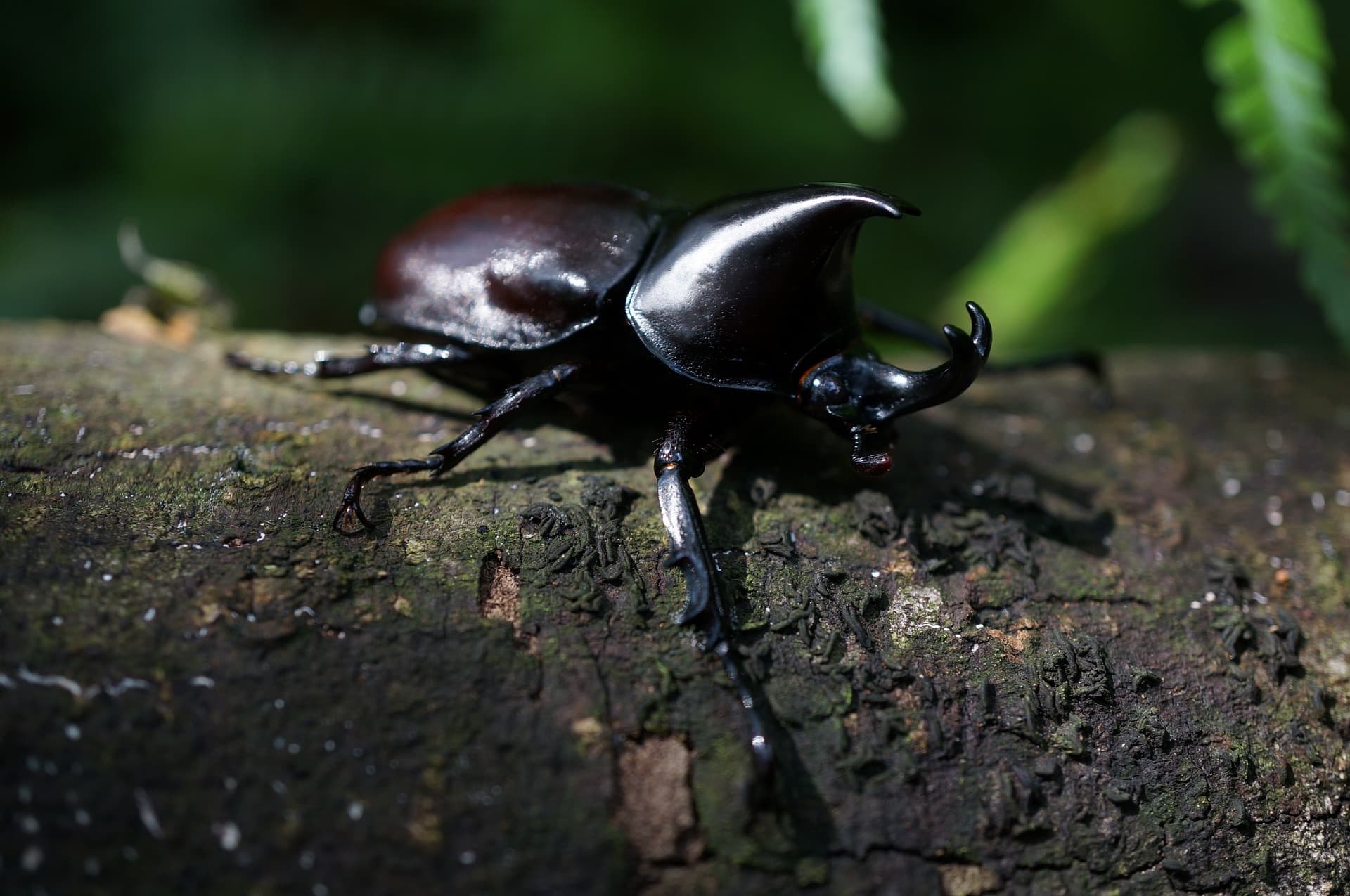
The beetle is a coleopteran insect with an often rounded body, 3 pairs of legs, 2 club-shaped antennae, 2 pairs of wings, one pair of which are sturdy elytra that cover the second pair of wings used for flight.
They lay their eggs in the soil. Beetles have a more or less long life cycle depending on the species. The larvae stay in the soil or in decomposing matter (dead wood, compost...) during their development and come out once they are adult.
Beetles are polyphagous and, depending on the species, they can have different preferences in the larval and the adult stage; they can be phytophagous, frugivorous, rhizophagous, coprophagous or saproxylophagous. For example, some species, push a ball of dung that they feed on and in which they lay their eggs before burying it. That way the larvae will already have something to feed on when they are born. Inside what has been discarded, the beetle finds the food it needs to survive, thanks to an intestinal system whose precision, fineness and incredible sensitivity surpass those of any mammal.
From this dung, the beetle draws the substance suited to producing that shell so magnificent that we know it for and that moves our eye: the jade green of the beetle of China, the purple red of the beetle of Africa, the jet black of the beetle of Europe and the treasure of the golden beetle, the most mythical of all, impossible to find, mystery of mysteries.
Beetles are the animals that can carry the most times their own weight. The rhinoceros beetle holds the record and can carry up to 850 times its own weight. An emblem of royal power, the beetle was familiar to the ancient Egyptians.
In the course of mummification, it even ended up taking the place of the heart of the deceased. To grasp the meaning of this strange belief, perhaps it is enough to look at the animal closely. And to discover its head, in the shape of a radiating half-disc, like a sunrise, evoking the eternal beginning again.
For shamans, the Beetle is an inspiring totem. It walks on the earth, is able to fly and to bury itself for a long time. So, like the shamans, by burying itself, it has the power to meet the worlds below. The worlds of the unconscious, of the psyche, of repressed urges, it is able to fly to visit the worlds above and the middle world, the world of earthly reality. That is why this powerful totem has been worn as an amulet or as a jewel of jade, of mother-of-pearl, of lapis lazuli for more than ten thousand years.
BIOMIMICRY
The beetle of the Namibian desert has developed a technique for drinking. Thanks to its shell with hydrophilic bumps, alternating with hydrophobic hollows, and when the fog rises over the desert, the beetle positions itself in the direction of the wind. The fog forms a water vapour that concentrates on the bumps, forming droplets. Little by little they start to slide down to the mouth of the beetle.
Following this observation, the two English zoologists, Andrew Parker and Chris Laurence, therefore had the idea of making dew-catching nets reproducing this technique in order to recover water, which in places on earth is becoming an increasingly rare resource.
Vegavision