The Eye of the Cyclone
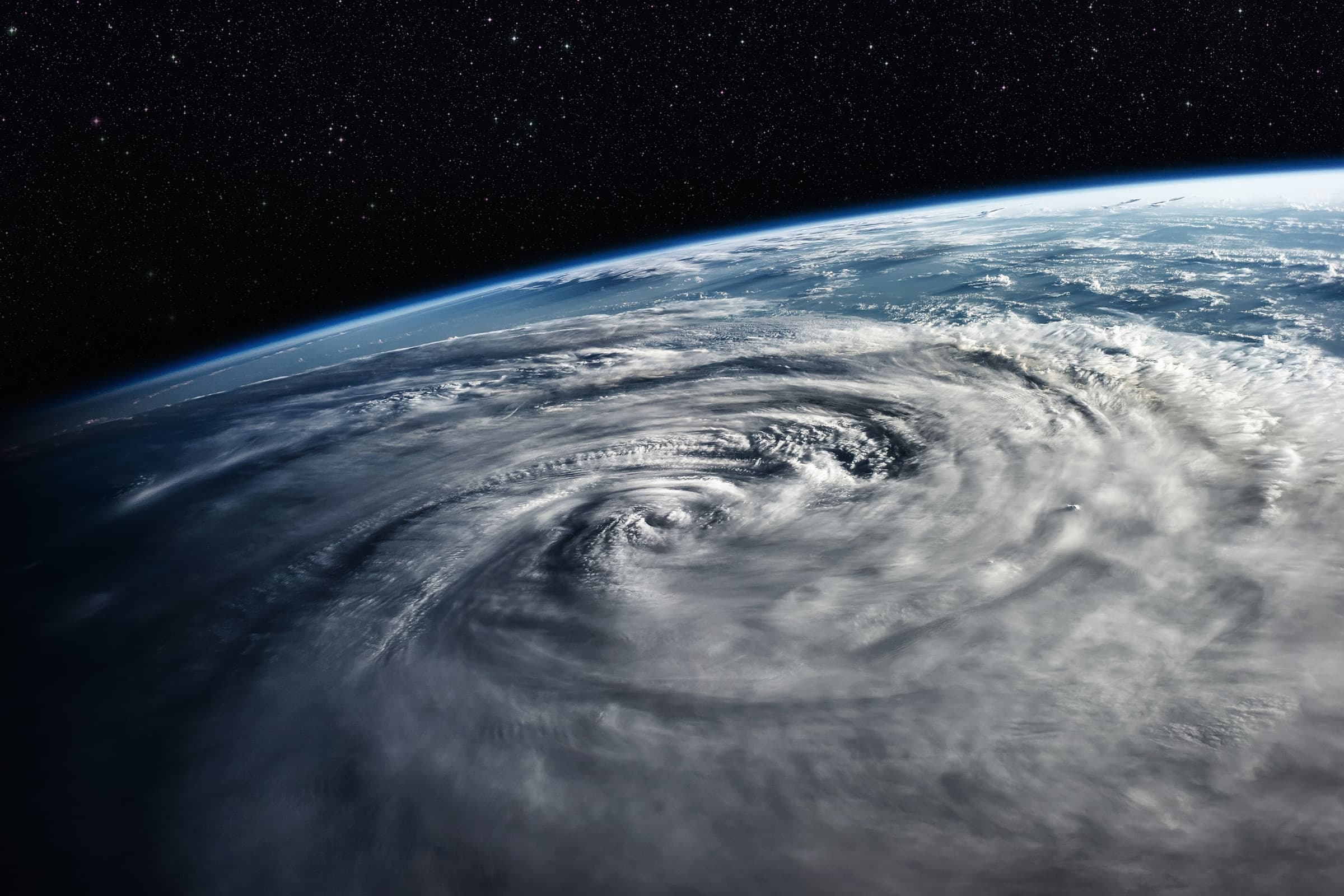
A cyclone is a formidable thermodynamic machine that “consumes” thousands and thousands of cubic kilometres of air. These movements of air, extremely violent, generate gigantic meteorological phenomena that develop a considerable energy, equivalent to that of several atomic bombs per second!
The eye of a tropical cyclone is a zone of calm winds at the centre of the cyclonic circulation. It is bounded by the eye wall, a wall of storms where the weather conditions are the most extreme. It is more or less circular and its characteristic diameter is of the order of 30 to 60 kilometres, although this diameter varies greatly according to the intensity of the system. The pressure there is the lowest of the system, but the temperature at altitude is higher than the surroundings, unlike a classic depression which has a cold heart. It sometimes happens that the eye is not at the centre and turns or moves in various directions around the centre of the cyclone. The waves converge, however, beneath the eye, making the sea very dangerous.
Inside the zone covered by the eye, the air undergoes powerful downward movements. This subsidence hinders the formation of clouds and frequently manages to make them disappear. That is how the relatively clear sky that is most often observed in this zone is explained. Likewise, this compression of the layers of air downwards causes a rise in temperature; in fact, temperatures are frequently higher inside the eye than outside. When the masses of air reach the ocean, they take on a swirling movement under the effect of the Coriolis force and diverge, undergoing a centrifugal force that tends to carry it outwards. At the same time, the air that is at the surface, above the ocean, some distance from the cyclone, is drawn towards the centre of the latter, that is to say towards the eye. The pressure, very low inside the eye, can be compared to a real well that draws the air in irresistibly. The air moves in spirals and whirls faster and faster as it gets closer to the centre. It runs into the centrifugal force exerted by the downward movements of the eye. As a result, it is abruptly thrown up into the heights. This warm, light, very humid air causes the formation of enormous clouds. It is a real wall of storm clouds that then surrounds the eye of the cyclone. The condensation of the water vapour then releases latent heat, which increases the process still further and constitutes in a way the “fuel” of the cyclone.
Faced with this power, nature teaches us humility, that nothing is guaranteed on earth and that our constructions are nothing but wind. We must learn to work with her, to listen to her, rather than to impose ourselves.