Octopus.... Alien of the seas
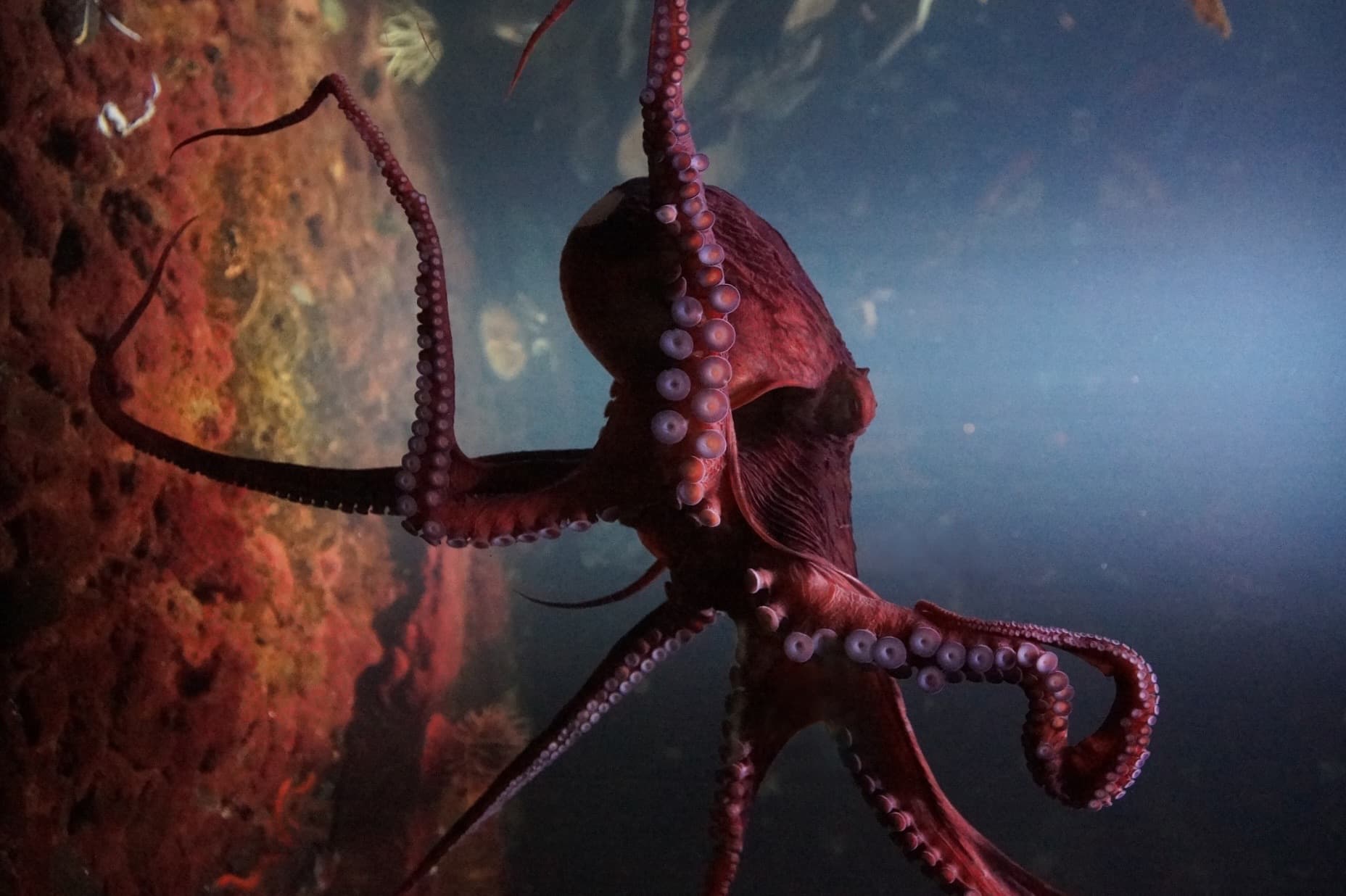
Cephalopods...Octopuses...Octopus,
are strange and surprising beings.
This class of animals, which we place in the phylum of the Molluscs, have developed such powerful learning and memorising abilities that some have even been able to speak of unprecedented forms of intelligence.
9 brains, 3 hearts, 8 arms, gigantic eyes and extraordinary intelligence, here are beings you would think had come from an imaginary world. With colours changing faster than the eye can perceive, these animals (octopuses, squid, cuttlefish...) have won themselves a prime place in popular and scientific culture.
It is thanks to these beings that we have been able to work out how our own brain functions, despite the millions of years that separate us, and research is only just beginning to take an interest in the potential of a body that is soft and yet constantly in movement.
Every region has at least one species of octopus, sometimes several. It is therefore normal that Octopus vulgaris, like its cousins the world over, should be found in artistic representations, in stories and in legends all over the planet.
In the Hawaiian creation myth, the universes are built one after another, on the ruins of the previous universe. The octopus is said to be the only survivor of the world that preceded ours.
All the countries on the shores of the Mediterranean have used octopuses in their artistic representations, some are found in caves of Minos dating from the Bronze Age. They are numerous on the vases, the amphorae and the frescoes of the Greek and Roman periods. The octopus, a symbol of regeneration and of transcendence, it also symbolises regeneration, because when one of its tentacles is cut off, that limb can grow back.
In the past, the kraken, a mythological animal, frightened sailors. Smell, touch, sight. With its 300 million neurons, the octopus’s brain works wonders. From the egg to adulthood, this marine alien stores up knowledge and is said to possess a form of proto-consciousness.
Although they see only in black and white, octopuses are aces of camouflage. Their brain commands millions of skin cells (the chromatophores) which dilate to make different colours appear or contract to show only the underside of the skin, change patterns in a fraction of a second, and their combinations are infinite. It takes a chameleon several minutes.
When an octopus watches a film containing subliminal images of crabs, its skin changes colour without this activating its predatory behaviour, this sort of proto-consciousness allows it to tell fiction from reality.
If the octopus has the nerve structures that produce consciousness, deciphering this mechanism would make it possible to explain how and why consciousness developed differently in vertebrates and invertebrates 600 million years ago. And one day, perhaps, to create a synthetic “Consciousness” or robots as gifted as these cephalopods.
BIOMIMICRY
The suckers used by the octopus for hunting, mobilising its prey, have inspired man, who has adapted these principles of adhesion to use them in everyday life as effective fasteners.
Used during surgery, this medical robot inspired by the octopus’s tentacles can bend, slip through, stiffen, to allow surgeons to reach areas of the human body that are hard to access without damaging the organs and to limit the incisions.
Vegavision, from another point of view.