Divine Wrath
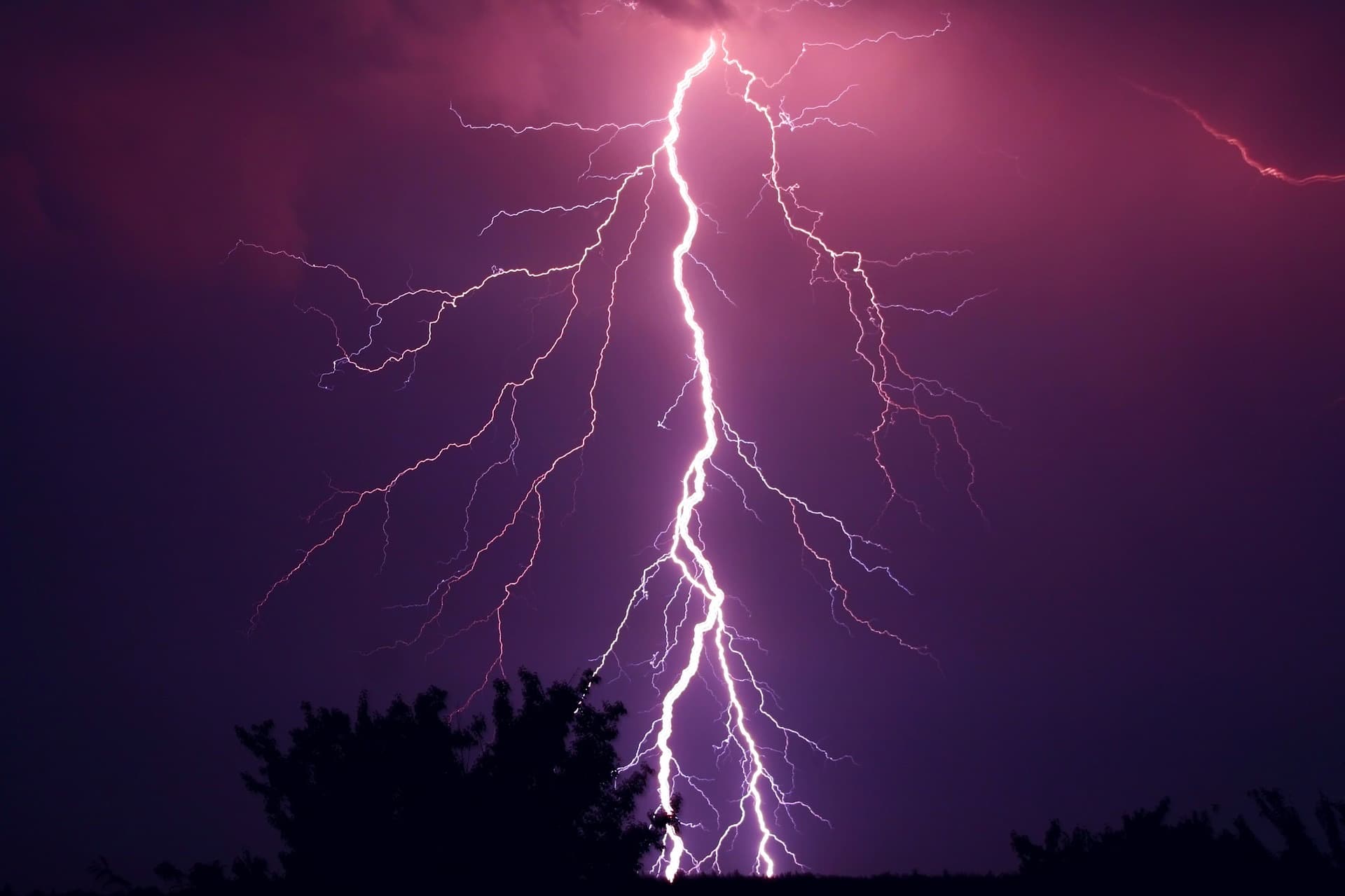
Lightning is a natural phenomenon of electrical discharge occurring inside a cloud, between clouds or between the cloud and the ground. ⚡️
When a cold front meets a warm front, the first passes underneath the second, creating upward and downward winds in the cumulonimbus clouds, which can be several kilometres thick. Opposite electrical charges are created, the lower part of the cloud becoming negatively charged while the upper part becomes positively charged.
Under the influence of the clouds, the ground in turn acquires positive charges.
When the build-up of all these charges becomes too strong, the flash bursts from the base of the negatively charged cloud and strikes a positively charged object, regularly another cloud, since lightning generally occurs from one cloud to another. Lightning does in fact strike the ground only about one time in four.
The temperature of a flash of lightning can reach 30,000 degrees Celsius. When the flash pierces the air, its heat expands the air and causes a sudden expansion, thereby creating an acoustic wave that we call thunder. As light travels faster than sound, we see the flash before we hear the thunder.
In Antiquity, lightning was the subject of many superstitions. Not knowing how to interpret this phenomenon rationally, people generally associated it with a deity. Many examples of these beliefs are found on every continent.
The Romans and the Greeks, for example, practised the cult of Jupiter or of Zeus, the god ruling over the sky and master of thunder. The appearance of lightning in the sky was therefore generally, for these peoples, a sign of the God's anger. That said, these beliefs did not stop certain Roman and Greek philosophers and physicists from taking an interest in the question in a scientific way, thereby laying the foundations of modern science.
In the Middle Ages, in a Europe dominated by Christianity, the lightning seen during a storm was considered the expression of divine anger in response to the sins committed by the faithful. Several customs existed to protect oneself from it: one, practised by peasants, consisted in slipping a fulgurite into your pocket in stormy weather while saying: “Stone, stone, keep me from the thunder”. A fulgurite is a glass formed when lightning strikes sand. This glass, being very impure, is not transparent.
René Descartes (1596-1650) is the first of the Christian philosophers to attempt an explanation of this phenomenon. He takes up the words of Seneca (a philosopher of Antiquity) for his theory. “Thunder occurs when heavier, higher clouds fall onto others placed lower down. The air held between two clouds, compressed by this sudden fall, produces a great release of heat, from which come the light of the flash and the noise of the thunder.” But he was unable to explain why clouds pile up one above the other.
A Dutch physicist, Hermann Boerhaave (1668-1738), also put forward a theory in which he proves that the water particles the sun has lifted into the air form clouds and make up masses of ice. These melt under the effect of the sun in a few seconds, and this violent rubbing of the particles against one another produces a bursting noise (thunder) and flashes (the ignition of the components of the air). These theories were discussed at length by the scholars of the time, they mark the beginning of the experiments of the following century. Indeed, the 18th century marks the beginning of modern science, accompanied by a series of discoveries as dazzling as they were essential. The discovery of electricity raises new questions and makes it possible to give new explanations for certain phenomena.
Several experiments at that time made it possible to show the electrical nature of the storm and of lightning. The greatest advances were the work of Benjamin Franklin (1706-1790), notably thanks to the famous kite experiment.
Franklin finally carried out the experiment on 15 June 1752. He flew a kite in stormy weather. The hemp of the string was slightly damp, which made it conductive enough to charge a key attached to the string at its base. By bringing his finger close to the key, Franklin managed to produce an electric arc between his finger and the key, thereby proving the electrical nature of lightning. Today we can see how reckless Franklin was, who, luckily for him, did not have the idea of using a conducting wire! It was in fact claimed that the experiment had been slightly Romanticised…